This week started off warm and bright - the bees were continuing as if it were still summer as the temperature was nudging over 20 degrees each day. By Wednesday, thing changed - the night time temp fell to about 5 degrees, and we've had heavy rain and strong winds since then.
I thought the bees had given up, but today the rain stopped and the sun came out. It still only managed about 13 degrees this afternoon, but the girls were out and about and still brining in pollen from somewhere. - Michaelmas daisies are flowering in the garden, but mostly the bees seem to be foraging further afield. I'm still unsure where they go, but mostly they fly off over the neighbour's garden to the east, with a smaller number heading south from the hive. - This takes them directly down our garden, but not proved to be a problem in either case as yet. When the neighbours were out working on their pond, they did say that the bees were stopping over for water and there were a considerable number of them, but I don't think they really mind - I guess we will get to see that properly next year when we have a full summer of them with luck.
I've not opened the hive since the last visit - other than a quick look under the roof - nothing I really need to see currently, and so best just to leave them to their own devices. I guess we expect the numbers to start declining pretty sharply from here, and certainly there are more dead and dying bees around the hive than previously - I guess they are flying in pretty marginal temperature now and if they get too tired, they can't make it back.
Fingers crossed until the next time.
Saturday, 12 October 2013

Monday, 30 September 2013
Last look at the bees?
It's been two weeks since I last looked into the hive, and Sunday was warm and dry so I decided we'd have what may be the last look at the bees. They are still extremely busy during the warmest part of the day and managing to bring in masses of pollen from somewhere. - There seems to be some scrub / fallow fields round about which have variety of plants still in flower though they are spread pretty widely - the bees obviously know where to look and don't seem to have any problems finding good sources.
It was also time to remove the 'apiguard' which should have done it's job by now. We cleaned the varroa monitoring board and will leave that for a few days to measure the rate of mite drop - my suspicion is that it's still going to be higher than the 10 per day which is supposedly acceptable going into October, but we will see.
My helper for today was the boy - operating the smoker - a little too generously in some cases - too much smoke seems to make the bees cross rather than calming them down - it's a fine balance and clearly not easy for a 10 year old boy, the fascination of the smoker cum flame thrower can outweigh the 'minimum' of smoke necessary to have the desired effect....
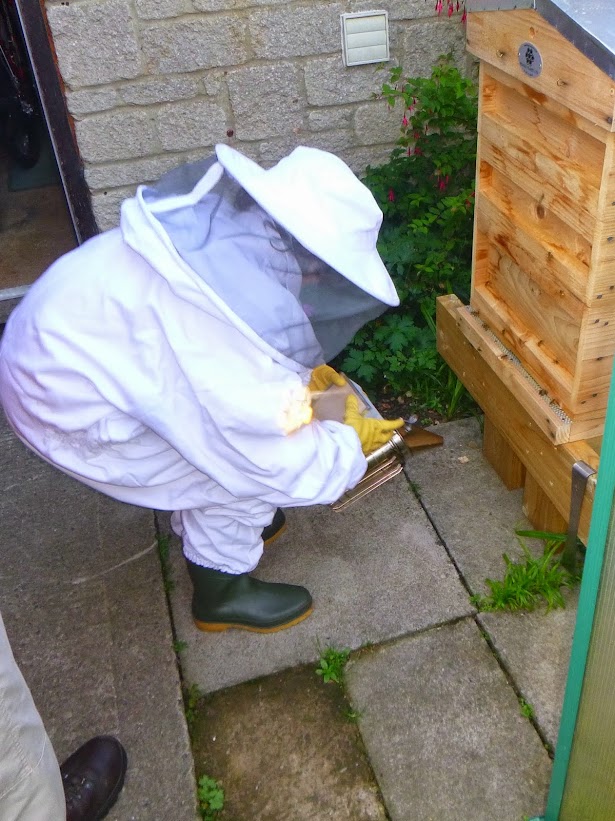
Anyway - going into the hive, we removed the 'empty' super which was really just on there to let the vapour from the apiguard circulate, removed the apiguard tray and then had a look at some of the frames without distubing them too much. - It still wasn't hot outside so didn't want to cool them more than necessary.
The top super is almost totally filled with capped honey now - barring the sides nearest the outside of the hive. It's a fair weight to lift that - the sort of weight you wouldn't want to be much heavier - that's a good thing as it's got to keep the bees going until next spring. I believe they need at least 20-25Kg of stores to see them through and the weight of the super is around that at a guess.
Going into the brood box - The outside couple of frames at each side are honey, then going into the frames, there is more pollen - I think they are putting pollen into some of the area previously used for brood which would make sense if the queen is starting to slow down laying. We didn't really look for brood, nor see the queen as the bees were getting a little touchy at this point. - There's little I can do this late in the year even if there were a problem with the queen, so better just let them get on and do their thing. - I'm pretty sure all is OK anyhow.
On this frame, you can see that it's got some capped honey round the edge and toward the left of the picutre, and then most of the rest of the frame is pollen. - You can see the different colours toward the right of the shot pretty well.

The bees hadn't really touched the last lot of syrup I'd put on there, but since it is still reasonably warm and dry, I left that on when we closed up the hive. Checking back tonight, they've nearly emptied the feeder so maybe they'd just not found it before. - The crown board is now directly on top of the super, and the feeder directly on top of that, so it's much easier for them to find the feeder than it was when I had the empty super on top of the 'stores' super. - Either way, I think this will be the last of the liquid feed I will give them this year. I might get some fondant feed to tide them over the winter if necessary - though how I know if they need it or not I'm not sure at this point.
Still a large number of bees around, though drones are increasingly rare when we stand watching them coming and going. - The poor drones get kicked out as they are unneeded mouths to feed over the winter. I guess we'd expect the number of workers in the hive to reduce too from this point, and there just to remain a core of workers to overwinter with the queen.
Jobs remaining to do...
1. - Think about insulation - maybe have a look at options to insulate the roof cavity, and potentially the outside of the hive.
2. - Check varroa drop & assess possible options for treatment if it's still high.
3. - Get some fondant food in.
I will keep looking in on them from time to time if the weather is warm enough, but that's going to be increasingly rare from this point on.
It was also time to remove the 'apiguard' which should have done it's job by now. We cleaned the varroa monitoring board and will leave that for a few days to measure the rate of mite drop - my suspicion is that it's still going to be higher than the 10 per day which is supposedly acceptable going into October, but we will see.
My helper for today was the boy - operating the smoker - a little too generously in some cases - too much smoke seems to make the bees cross rather than calming them down - it's a fine balance and clearly not easy for a 10 year old boy, the fascination of the smoker cum flame thrower can outweigh the 'minimum' of smoke necessary to have the desired effect....
Anyway - going into the hive, we removed the 'empty' super which was really just on there to let the vapour from the apiguard circulate, removed the apiguard tray and then had a look at some of the frames without distubing them too much. - It still wasn't hot outside so didn't want to cool them more than necessary.
The top super is almost totally filled with capped honey now - barring the sides nearest the outside of the hive. It's a fair weight to lift that - the sort of weight you wouldn't want to be much heavier - that's a good thing as it's got to keep the bees going until next spring. I believe they need at least 20-25Kg of stores to see them through and the weight of the super is around that at a guess.
Going into the brood box - The outside couple of frames at each side are honey, then going into the frames, there is more pollen - I think they are putting pollen into some of the area previously used for brood which would make sense if the queen is starting to slow down laying. We didn't really look for brood, nor see the queen as the bees were getting a little touchy at this point. - There's little I can do this late in the year even if there were a problem with the queen, so better just let them get on and do their thing. - I'm pretty sure all is OK anyhow.
On this frame, you can see that it's got some capped honey round the edge and toward the left of the picutre, and then most of the rest of the frame is pollen. - You can see the different colours toward the right of the shot pretty well.
The bees hadn't really touched the last lot of syrup I'd put on there, but since it is still reasonably warm and dry, I left that on when we closed up the hive. Checking back tonight, they've nearly emptied the feeder so maybe they'd just not found it before. - The crown board is now directly on top of the super, and the feeder directly on top of that, so it's much easier for them to find the feeder than it was when I had the empty super on top of the 'stores' super. - Either way, I think this will be the last of the liquid feed I will give them this year. I might get some fondant feed to tide them over the winter if necessary - though how I know if they need it or not I'm not sure at this point.
Still a large number of bees around, though drones are increasingly rare when we stand watching them coming and going. - The poor drones get kicked out as they are unneeded mouths to feed over the winter. I guess we'd expect the number of workers in the hive to reduce too from this point, and there just to remain a core of workers to overwinter with the queen.
Jobs remaining to do...
1. - Think about insulation - maybe have a look at options to insulate the roof cavity, and potentially the outside of the hive.
2. - Check varroa drop & assess possible options for treatment if it's still high.
3. - Get some fondant food in.
I will keep looking in on them from time to time if the weather is warm enough, but that's going to be increasingly rare from this point on.
Saturday, 14 September 2013
Hive Examination. - 14/09/13
Cooler today and rain forecast this afternoon. - About 14 degrees, so just wanted a quick look at the bees to see what the situation is following the second does of apiguard applied last weekend.
Bees are very busy this morning brining in masses of pollen. They have been taking over 1L of 'heavy' syrup each day containing 1Kg sugar, and they must have been doing something with it!
Opening the top of the hive, the bees are busy but not agressive. - There are a lot of them on all frames in the super.

Where previously there had been brood in the central frames of the super, they are now storing honey (syrup) in these frames, and apart from the outside sides, the frames are all drawn and filling with syrup / honey. Hopefully this is a good sign that they will have enough stores for the winter.
Moving down into the brood box, we saw plenty of stores in there too, capped brood, grubs and eventually the queen. - Again, all frames are full of bees - it all looks very much busier even than last week I think.
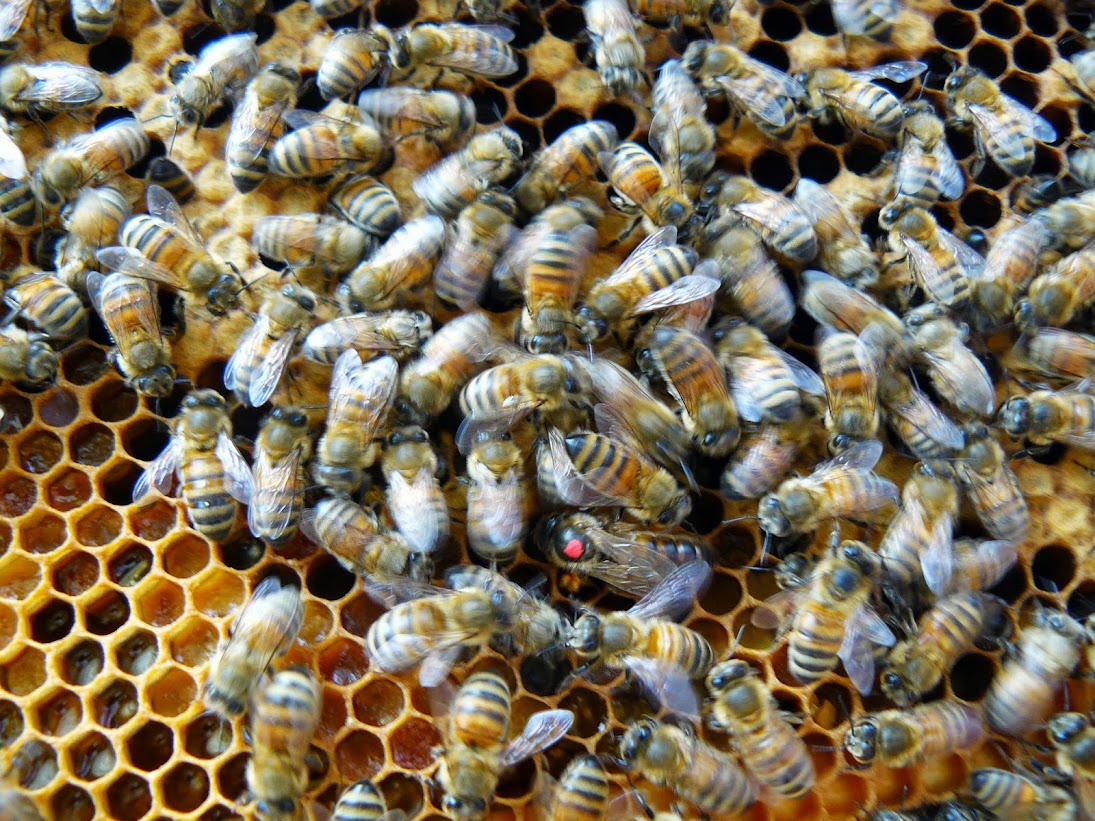
The girl was helping today and operated the smoker as required. Also held a frame stores from the brood box for the first time which she found very exciting.

There were few signs of queen cells - except those which were partially torn down from previously. - Having seen the queen, and seen signs of laying etc, then I think we conclude all is as well as can be hoped at this stage. - Feeling pretty happy after examination today!
I think we will continue feeding for a little while longer and I will seek advice on when to stop. I'm assuming that the bees will stop taking the syrup when they feel they have had enough but unsure so need to check.
Bees are very busy this morning brining in masses of pollen. They have been taking over 1L of 'heavy' syrup each day containing 1Kg sugar, and they must have been doing something with it!
Opening the top of the hive, the bees are busy but not agressive. - There are a lot of them on all frames in the super.
Where previously there had been brood in the central frames of the super, they are now storing honey (syrup) in these frames, and apart from the outside sides, the frames are all drawn and filling with syrup / honey. Hopefully this is a good sign that they will have enough stores for the winter.
Moving down into the brood box, we saw plenty of stores in there too, capped brood, grubs and eventually the queen. - Again, all frames are full of bees - it all looks very much busier even than last week I think.
The girl was helping today and operated the smoker as required. Also held a frame stores from the brood box for the first time which she found very exciting.
There were few signs of queen cells - except those which were partially torn down from previously. - Having seen the queen, and seen signs of laying etc, then I think we conclude all is as well as can be hoped at this stage. - Feeling pretty happy after examination today!
I think we will continue feeding for a little while longer and I will seek advice on when to stop. I'm assuming that the bees will stop taking the syrup when they feel they have had enough but unsure so need to check.
Sunday, 8 September 2013
Fingers crossed - things might be more positive.
Weather is definitely turning cooler. This morning's bike ride was distinctly cold, and we'd already had a couple of showers. Temperature approx 13 degrees, but when the sun came out around midday it was pleasant enough to open the bees.
Today's plan was to follow up on the previous situation - see what had happened to the queen cells / supersedure cells and see if we could see evidence that a queen is laying and active.
Several points were I think tentatively good news. Firstly, we saw the original queen (and didn't see any other queens). Secondly, we saw grubs. Since it's 6 days since we last opened the hive, it's highly significant that we've seen grubs. - When they fill the bottom of the cell prior to capping they have been there for about 8 days. This means they must have been eggs around the time we last looked - indicating the queen was laying at that time. - I'm taking this as a very positive sign that the queen is OK and not permanently off colour. In fact, there were a lot of grubs, and it seemed a lot of capped brood - and indeed, there seem to be more bees than previously though that might just be that it's not a particularly good flying day I guess.
The third point of interest was that ALL the supersedure / queen cells (of which previously about 5) were open. - We know that they were all sealed 6 days ago on 2nd September, so they have either hatched, or they have been torn down by the bees. - What has happened here I've no idea. - Either the virgin queen(s) hatched, and there is still a virgin somewhere in the hive along with her mother, or the existing queen killed the new queen(s), or the bees did either before or after hatching. - Comments welcome below.
Here you can see quite a few grubs / larvae just to the right of centre of the shot (shiny white things in the bottom of some of the cells.)

And here you can see one of the previous sealed queen cells is torn down - I guess it's being tidied away by the workers. - It's the bigger cell to the left of shot. The one in the centre isn't so big and probably was never a proper queen cell.
An interesting thing I learned at the demo yesterday is that 'supersedure' queen cells tend to be built in the middle of the brood frames - perpendicular to the 'normal' direction of cells in the honeycomb. - This contrasts with 'swarm' queen cells which would tend to be built at the edges or the bottom of frames. If this is true, the bees must have some reason for making the differently positioned cells - either something to do with temperature maybe, or the way the new queen's pheromone will affect the hive. - Clearly they know why they do it that way, but I don't.

So - in conclusion - we now have a hive which appears to have a laying queen, and the prior queen cells are not active. On that basis, I added the second does of Apiguard varroa treatment which was supposed to be added 2 weeks after the first. I 'hope' that if it were that which affected the queen previously they will now be more used to it, and it won't be so destructive this time. There are as I said a 'lot' of bees, and there seems to be quite a lot of capped brood. The 'super' is now heavy with 'honey' (probably mostly acutally syrup) with most frames filled and capped except where there's brood in the centre frames, so for now I'm quite a bit happier than I was the last couple of times I have examined the hive.
The only thing I saw this time which I've not seen before were just a couple of 'bald' brood. Since there were only a few, I doubt this is anything to fret over. You can see these partial cappings with the brood visible in the photo below.

I added the varroa floor again today and will count the mite drop at the next examination.
Far more relaxed this time round (me, not the bees). I've sort of resigned myself that 'what will be will be', and that this is after all a learning experience.
OK - we will examine again in about a week or less and see what surprises they are trying to scare me with at that time!
Today's plan was to follow up on the previous situation - see what had happened to the queen cells / supersedure cells and see if we could see evidence that a queen is laying and active.
Several points were I think tentatively good news. Firstly, we saw the original queen (and didn't see any other queens). Secondly, we saw grubs. Since it's 6 days since we last opened the hive, it's highly significant that we've seen grubs. - When they fill the bottom of the cell prior to capping they have been there for about 8 days. This means they must have been eggs around the time we last looked - indicating the queen was laying at that time. - I'm taking this as a very positive sign that the queen is OK and not permanently off colour. In fact, there were a lot of grubs, and it seemed a lot of capped brood - and indeed, there seem to be more bees than previously though that might just be that it's not a particularly good flying day I guess.
The third point of interest was that ALL the supersedure / queen cells (of which previously about 5) were open. - We know that they were all sealed 6 days ago on 2nd September, so they have either hatched, or they have been torn down by the bees. - What has happened here I've no idea. - Either the virgin queen(s) hatched, and there is still a virgin somewhere in the hive along with her mother, or the existing queen killed the new queen(s), or the bees did either before or after hatching. - Comments welcome below.
Here you can see quite a few grubs / larvae just to the right of centre of the shot (shiny white things in the bottom of some of the cells.)
And here you can see one of the previous sealed queen cells is torn down - I guess it's being tidied away by the workers. - It's the bigger cell to the left of shot. The one in the centre isn't so big and probably was never a proper queen cell.
An interesting thing I learned at the demo yesterday is that 'supersedure' queen cells tend to be built in the middle of the brood frames - perpendicular to the 'normal' direction of cells in the honeycomb. - This contrasts with 'swarm' queen cells which would tend to be built at the edges or the bottom of frames. If this is true, the bees must have some reason for making the differently positioned cells - either something to do with temperature maybe, or the way the new queen's pheromone will affect the hive. - Clearly they know why they do it that way, but I don't.
So - in conclusion - we now have a hive which appears to have a laying queen, and the prior queen cells are not active. On that basis, I added the second does of Apiguard varroa treatment which was supposed to be added 2 weeks after the first. I 'hope' that if it were that which affected the queen previously they will now be more used to it, and it won't be so destructive this time. There are as I said a 'lot' of bees, and there seems to be quite a lot of capped brood. The 'super' is now heavy with 'honey' (probably mostly acutally syrup) with most frames filled and capped except where there's brood in the centre frames, so for now I'm quite a bit happier than I was the last couple of times I have examined the hive.
The only thing I saw this time which I've not seen before were just a couple of 'bald' brood. Since there were only a few, I doubt this is anything to fret over. You can see these partial cappings with the brood visible in the photo below.
I added the varroa floor again today and will count the mite drop at the next examination.
Far more relaxed this time round (me, not the bees). I've sort of resigned myself that 'what will be will be', and that this is after all a learning experience.
OK - we will examine again in about a week or less and see what surprises they are trying to scare me with at that time!
Saturday, 7 September 2013
Bristol Bee and Pollination Festival
We spent the afternoon at the Bristol Bee and Pollination Festival. This was at the University of Bristol Botanic Garden - not somewhere I've been before, but a fascinating garden. Lots of bright and exotic flowers, trees and shrubs and several glasshouses with interesting orchids, banana plants etc.
A large marquee housed honey displays, a live exhibition hive and stalls about bumble bees and other pollinators.
The live beekeeping demonstration was held just as the weather was turning cold, but the beekeeper (Garth Chatham) was engaging and entertaining and held the crowd enthralled looking through a small colony in a mesh tent. Great to see the children so interested in all that was going on in the hive and during the demo.
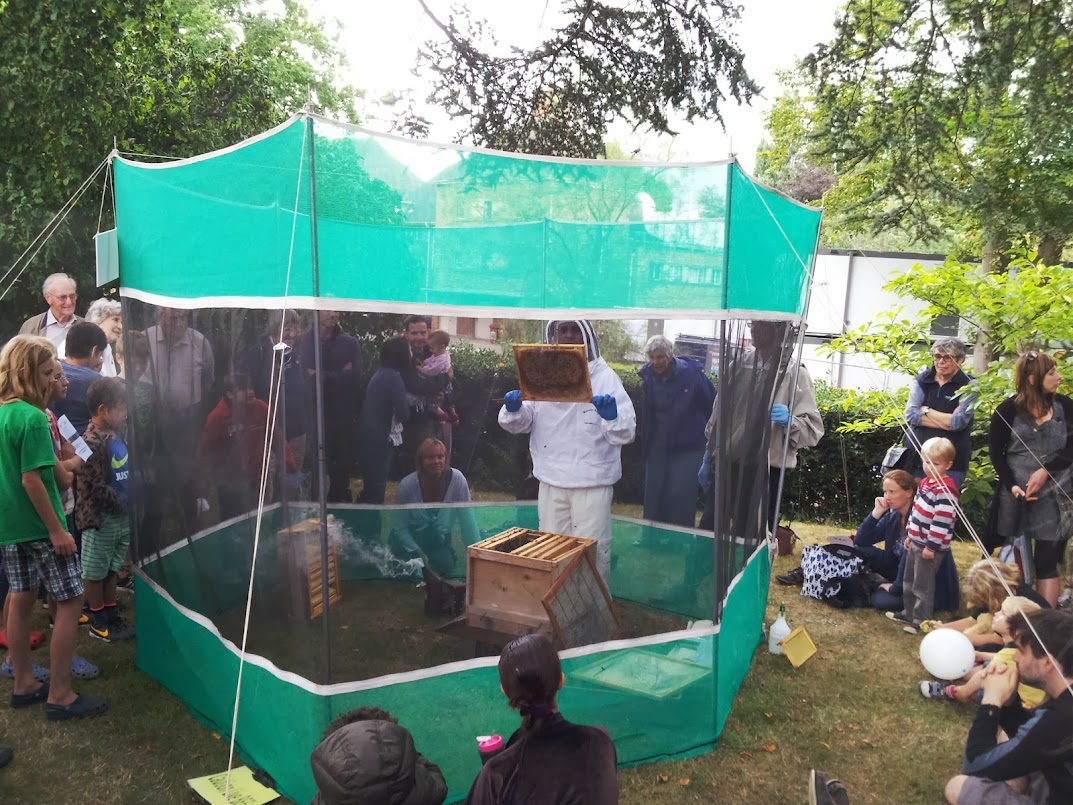
Many honey bees and other insects in evidence on the flowers around the garden - at least before the rain came....

As to our own bees - they are still happy doing bee things. I will inspect again shortly to see what's happening with the queen situation. - Watch this space.
A large marquee housed honey displays, a live exhibition hive and stalls about bumble bees and other pollinators.
The live beekeeping demonstration was held just as the weather was turning cold, but the beekeeper (Garth Chatham) was engaging and entertaining and held the crowd enthralled looking through a small colony in a mesh tent. Great to see the children so interested in all that was going on in the hive and during the demo.
Many honey bees and other insects in evidence on the flowers around the garden - at least before the rain came....
As to our own bees - they are still happy doing bee things. I will inspect again shortly to see what's happening with the queen situation. - Watch this space.
Tuesday, 3 September 2013
Still wondering....
After examining the hive yesterday, and making a possible connection to the Apiguard, I did a little googling and asked an expert for an opinion. The answer from both seems to be uncertain. There is certainly the possibility that the Apiguard is the cause - maybe it stopped the queen laying, and I suspect that in itself could have triggered supersedure proceedings from the bees.
The positive thing is that the queen is still here, and the bees appear to be behaving as normal - brining in plenty of pollen and taking syrup etc so I'm increasingly sure they are not leaving. Supersedure might not be the best thing to happen at this time when there are limited drones to mate with, but it could be that the current queen will 'recover' in time to prevent it, or there may even be some sort of co-existence with the new queen until she is mated etc.
So - I think the way forward at the moment is to carry on as before. - Complete the varroa treatment, and see what happens. The reality is that there's not much I can do to modify what the bees think is best for them, and if they want to supersede the queen, they will. - So, I might as well just relax a bit, enjoy them and see what happens - whatever it is will be a learning experience. Maybe what I've already learned is 'ask before you act!'
Another warm sunny day, and the sedum is just coming out in the garden. For the first time we saw our bees on it - it's been worked by the bumble bees for a while, but is now interesting the honey bees.

The positive thing is that the queen is still here, and the bees appear to be behaving as normal - brining in plenty of pollen and taking syrup etc so I'm increasingly sure they are not leaving. Supersedure might not be the best thing to happen at this time when there are limited drones to mate with, but it could be that the current queen will 'recover' in time to prevent it, or there may even be some sort of co-existence with the new queen until she is mated etc.
So - I think the way forward at the moment is to carry on as before. - Complete the varroa treatment, and see what happens. The reality is that there's not much I can do to modify what the bees think is best for them, and if they want to supersede the queen, they will. - So, I might as well just relax a bit, enjoy them and see what happens - whatever it is will be a learning experience. Maybe what I've already learned is 'ask before you act!'
Another warm sunny day, and the sedum is just coming out in the garden. For the first time we saw our bees on it - it's been worked by the bumble bees for a while, but is now interesting the honey bees.
Monday, 2 September 2013
Situation analysis - More relaxed hive inspection.
So, it's two days since I last went into the hive. At that time, I annoyed the bees by dusting with icing sugar. - I wasn't relaxed, and they certainly weren't. Worryingly, I didn't see the queen, and I found several sealed queen cells. - The queen cells, and the rowdy bees at that time meant I wasn't really concentrating on what I should have been, and didn't do a good job at evidence gathering. - So, my plan was leave them alone for a day or two and take a proper look at what was going on. - I left work at lunch time today as the weather was due to be warm, and intended to have a better look around. Specifically, could I see eggs, and could I see the queen. Then, I might have enough evidence to contact someone more knowledgeable.
In the 'super', we have a good frame here showing some capped brood, some pollen surrounding, and some honey around that.

Here we can see capped brood, pollen and around the centre of the picture, a couple of uncapped lavae. From what I understand, at the stage they fill the bottom of the cell like this, they were probably eggs laid around 8 days ago. - So, we know the queen was laying at that time.

Here's a frame from the brood box - Not a bad shot showing the grubs at the left hand side of the frame - looking like children's teeth as I believe they should.

I still couldn't see eggs anywhere - the next two shots show some of the queen cells we found. This one appears sealed.


So, in conclusion we've seen grubs, capped brood, we've seen the queen, though we have not seen eggs - which in any case are hard to see, and we've seen several capped queen cells. I wonder if the apiguard has put the queen off laying properly, and this could have caused the bees to build queen cells? Anyway, I think I've now got enough of an idea of what's in the hive to ask someone more expert which will be my next move.
In the 'super', we have a good frame here showing some capped brood, some pollen surrounding, and some honey around that.

Here we can see capped brood, pollen and around the centre of the picture, a couple of uncapped lavae. From what I understand, at the stage they fill the bottom of the cell like this, they were probably eggs laid around 8 days ago. - So, we know the queen was laying at that time.

Here's a frame from the brood box - Not a bad shot showing the grubs at the left hand side of the frame - looking like children's teeth as I believe they should.

I still couldn't see eggs anywhere - the next two shots show some of the queen cells we found. This one appears sealed.

There are two cells in this next shot, but one of them appears damaged - I don't think 'hatched' - maybe just not viable.

Finally as we were beginning to give up hope of finding the original queen, my daughter's eagle eyes spotted her.

Saturday, 31 August 2013
Next hive inspection.
Nice weather this Saturday morning, and more than time I had another check on the bees. I also wanted to dust them with icing sugar which is futher supposed to help them clear the varroa mites. - I think the reasoning is that they 'groom' each other and pull off some of the mites. - Also, I guess the sugar might irritate the mites and cause them to fall off. Certainly, the varroa board had a lot of 'live' mites on it after I'd dusted the bees - these I disposed of well away from the hive, and left the board off. I'll leave the bottom open for a few days and then check the mite drop properly to get a better picture of how it's going.
Something I read said you should always have a plan when opening the hive - a reason for doing so. Well, today I really just wanted to check that all was in order and dust the bees with icing sugar - that was the plan.
 Little smoke to let them know we are coming.
Working down through the hive - they've taken about half of the Apiguard, or it's evaporated - hopefully the large number of mites on the drop board shows they are dying.

Looks like they are filling the upper super with syrup, and some brood too - as expected. They still haven't filled the outer couple of frames but maybe they will - they have about a month yet before the start of winter.
Working through the super, I sprinkled the bees with icing sugar as I went. Here's a pretty full frame from the super.

Moving into the brood box was a little more fraught. Firstly, I didn't see the queen anywhere today. - There were some grubs, and I always struggle to see eggs, but I'm really not convinced there were 'many' grubs. More worryingly, there were what appear to be three sealed queen cells - no photo's of these, but you can just make out some grubs to the top right of this photo.
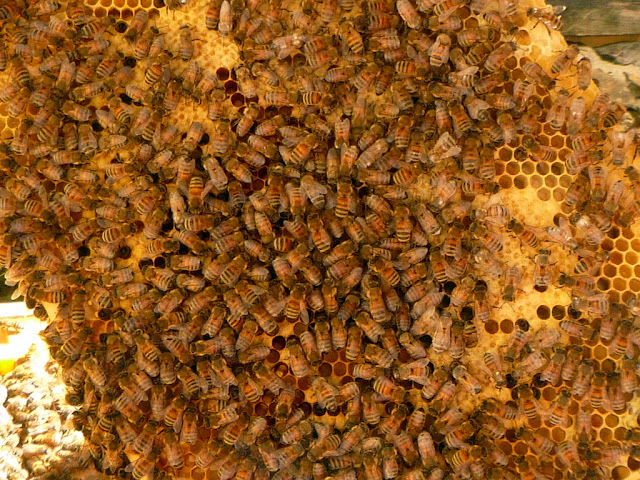
So - at this stage, the bees were getting pretty agitated - they really didn't like being dusted with sugar, though as I mentioned, it does seem to have a pretty immediate effect on the mites - there were several on the varroa board, clearly alive after the dusting which may have just come off. However, since the bees were getting rowdy, and I'd not seen the queen and I've seen queen cells, I finished off quickly and need to take some time do decide on next moves. - Might need to contact someone more knowledgeable than myself to know what I might need to do, but first - let's assess the possibilities.
1. - Firstly - don't panic! I last inspected the hive 10 days ago, and there were no sealed queen cells at that time and what looked like 'play cups' were small and we removed them anyway. - So, if we assume that they only started building queen cells after that point, then they would have been sealed about 2 days ago at day 8. (Queen emerges from cell at day 16 after egg layed).
2. - I think it's pretty late in the year for the bees to think about swarming, and anyway, why would they? They have plenty of room and are not big enough to swarm surely? - Don't think this would be the reason. Also, my understanding is that if they were going to swarm, they would most likely do so after the new queen cell(s) were sealed. - Since they've not yet swarmed, then it could be they are not going to.
3. - Though I didn't see the queen, that in itself is not unusual - I was somewhat flustered by the bees reaction to being dusted and their increasing agitation, so it would be easy to miss her. - She may still be present. That could indicate the bees might be planning to supersede the queen - In this case, I probably don't need to do anything other than let nature take it's course. - However, if this is the case, then again it's very late to supersede the queen. - There will be decreasing numbers of drones available for her to mate with and this would surely doom the colony at this time of the year?
4. - Something has happened to the queen - either yours truly squashed her on the last examination, she was attacked by the evil wasps, or has succumbed to disease of some sort. - I guess all these are possibilities, and if the case then we need a new queen and I should again let nature run it's course.
So - I just don't know for sure. Since the bees are still here, what I think I should do is go into the hive again in a day or two and check more carefully - 1. - look for eggs with magnifying glass etc. - 2. - Try to find the queen. - 3. - Once we have situation fully assessed properly, contact some members of the club for advice.
Interesting examination today - watch this space!
Something I read said you should always have a plan when opening the hive - a reason for doing so. Well, today I really just wanted to check that all was in order and dust the bees with icing sugar - that was the plan.

Working down through the hive - they've taken about half of the Apiguard, or it's evaporated - hopefully the large number of mites on the drop board shows they are dying.

Looks like they are filling the upper super with syrup, and some brood too - as expected. They still haven't filled the outer couple of frames but maybe they will - they have about a month yet before the start of winter.
Working through the super, I sprinkled the bees with icing sugar as I went. Here's a pretty full frame from the super.


So - at this stage, the bees were getting pretty agitated - they really didn't like being dusted with sugar, though as I mentioned, it does seem to have a pretty immediate effect on the mites - there were several on the varroa board, clearly alive after the dusting which may have just come off. However, since the bees were getting rowdy, and I'd not seen the queen and I've seen queen cells, I finished off quickly and need to take some time do decide on next moves. - Might need to contact someone more knowledgeable than myself to know what I might need to do, but first - let's assess the possibilities.
1. - Firstly - don't panic! I last inspected the hive 10 days ago, and there were no sealed queen cells at that time and what looked like 'play cups' were small and we removed them anyway. - So, if we assume that they only started building queen cells after that point, then they would have been sealed about 2 days ago at day 8. (Queen emerges from cell at day 16 after egg layed).
2. - I think it's pretty late in the year for the bees to think about swarming, and anyway, why would they? They have plenty of room and are not big enough to swarm surely? - Don't think this would be the reason. Also, my understanding is that if they were going to swarm, they would most likely do so after the new queen cell(s) were sealed. - Since they've not yet swarmed, then it could be they are not going to.
3. - Though I didn't see the queen, that in itself is not unusual - I was somewhat flustered by the bees reaction to being dusted and their increasing agitation, so it would be easy to miss her. - She may still be present. That could indicate the bees might be planning to supersede the queen - In this case, I probably don't need to do anything other than let nature take it's course. - However, if this is the case, then again it's very late to supersede the queen. - There will be decreasing numbers of drones available for her to mate with and this would surely doom the colony at this time of the year?
4. - Something has happened to the queen - either yours truly squashed her on the last examination, she was attacked by the evil wasps, or has succumbed to disease of some sort. - I guess all these are possibilities, and if the case then we need a new queen and I should again let nature run it's course.
So - I just don't know for sure. Since the bees are still here, what I think I should do is go into the hive again in a day or two and check more carefully - 1. - look for eggs with magnifying glass etc. - 2. - Try to find the queen. - 3. - Once we have situation fully assessed properly, contact some members of the club for advice.
Interesting examination today - watch this space!
Tuesday, 27 August 2013
Evening gatherings.
The last couple of days have been lovely weather. The bees have been very busy, brining in pollen and presumably nectar, and they've not been taking a whole lot of the food since I last gave them some, some 5 days ago. I think this is partly because I upset them somewhat putting in the 'Apiguard', and partly that the food is now on top of the empty super - they need to work harder to find it. - They are still taking some, but whilst the weather is good, and they can get their own nectar, that's got to be better for them than sugar water anyhow.
So - a behaviour I've noticed is that when the evening begins to darken, the bees stop flying but there can be a large cluster of them outside the hive around the entrance, even until it's quite 'cold' and dark. - I've no idea why they would do this - the wasps don't seem to be a problem at this time of night - it's almost like they are just tired and having a little chat and relax before retiring for the evening - the old women of the hive gathering for a glass of sherry and a chat before bed.
Not so many in this shot, but there can be many more. - If you have any ideas, let me know!

So - a behaviour I've noticed is that when the evening begins to darken, the bees stop flying but there can be a large cluster of them outside the hive around the entrance, even until it's quite 'cold' and dark. - I've no idea why they would do this - the wasps don't seem to be a problem at this time of night - it's almost like they are just tired and having a little chat and relax before retiring for the evening - the old women of the hive gathering for a glass of sherry and a chat before bed.
Not so many in this shot, but there can be many more. - If you have any ideas, let me know!
Wednesday, 21 August 2013
Hive Inspection / Varroa treatment.
It was certainly time I had another look in the hive - the last time being 12th August which was 9 days ago. I had pencilled in an inspection yesterday, but was waiting for delivery of my 'Apiguard' varroa treatment before proceeding and this arrived in the post today.
There are varying opinions on the web regarding varroa, the levels you should treat at, when you should treat, and what with - this seems to be a common theme in beekeeping that there is no 'right' answer, so you just have to read a few sources, and make the best of it. - Hopefully the bees are pretty resilient to action and inaction. Anyway, the rates of mite drop are well above the levels where Defra recommend treatement, so I think it's probably not wrong to treat them now, and Apiguard is recommended for treatment in August.
This is my helper / photographer for this evening:-


There are varying opinions on the web regarding varroa, the levels you should treat at, when you should treat, and what with - this seems to be a common theme in beekeeping that there is no 'right' answer, so you just have to read a few sources, and make the best of it. - Hopefully the bees are pretty resilient to action and inaction. Anyway, the rates of mite drop are well above the levels where Defra recommend treatement, so I think it's probably not wrong to treat them now, and Apiguard is recommended for treatment in August.
This is my helper / photographer for this evening:-

So - what did we see in the hive today. - Well, last time on 12th August I added the super full of foundation. The bees have drawn out much of this comb, and filled it - I guess this is where the syrup has been going, but at least I know they have something to get them through the winter. There were a couple of frames at the edges which were not filled, so I moved these in one space. There was no sign of brood in the super. - Here you can see a frame from the super and how the bees have started capping off the cells at the top - Not sure where they've been putting all the pollen they seem to be bringing in.

Having had a look through the super, we put it to one side, and had a look at the brood box. - What I wanted to be sure of was that there was still evidence that the queen was well and laying OK. We actually saw her a few frames in, and saw some young pearly white grubs as they should be at the bottom of the cells - and capped brood. Couldn't see eggs, but I think that's just the light / my eyes, since there must have been eggs at some point for there to be young grubs. - Having seen the new grubs, and the queen I was happy for now. Nothing either that looked like proper queen cells to me, so all is good with the world. One of the frames at one side of the hive wasn't completely drawn out, and the one next to it only partly, so maybe I was a bit premature in putting on the super but maybe I can move it in a bit if still not drawn next time I look.
Finally, we put back the super, and added the Apiguard on top of that. - It's like a sort of minty smelling gel that the bees will eat, and clean out of the hive and spread it around hopefully removing a large proportion of the varroa mites in the process. - I will monitor varroa count again when treatment is complete in a month or so. - It's a two part treatment - leave one can of gel for 2 weeks then replace with another for (I think) 4 weeks. (http://www.vita-europe.com/products/apiguard/)

We put the varroa floor back in to partially seal the bottom of the hive and allow the vapours from the gel to be more active throughout the hive, then put an empty super on top of the stores super, crown board on top of that, and filled a feeder on top of the crown board.
Job's a good un! The bees were really very well behaved and didn't seem at all fazed by being opened. - I had warned the neighbours again, but they didn't bother them either. - One bee was getting a little fussy toward the end, banging into my veil, but only a couple of times - nothing nasty.
Looking forward to checking progress next week.
Subscribe to:
Posts (Atom)